
Picking a dining table sounds simple until you are standing in a furniture showroom, measuring tape in hand, completely torn between a gorgeous round walnut table and an elegant six-seater rectangular one. Both look right. Both feel right. So which one actually is right?
This question comes up constantly when homeowners are furnishing a new apartment, remodelling a villa, or simply replacing a worn-out table. And the honest answer is that the shape of your dining table affects how you live in your home far more than most people realise. It changes how conversations flow at dinner, how easily you can seat extra guests, and whether your dining room feels cramped or perfectly proportioned.
Quick Answer:
- Neither shape is universally “better.” The right choice depends on your room dimensions, family size, and lifestyle.
- Round tables work best in square rooms, smaller spaces, and for families of 2 to 4 who value conversation.
- Rectangular tables suit rectangular rooms, larger families of 6 or more, and formal dining setups.
- A round table with a pedestal base maximises legroom; a rectangular table maximises seating capacity.
- If you are still unsure after reading this guide, the answer is almost always: measure your room first, then decide.
Based on years of working with homeowners and interior designers on custom furniture projects, this guide breaks down the round vs rectangular dining table debate with precision. You will learn which shape suits different room sizes, family dynamics, interior styles, and budgets, so you can make a confident, informed decision.
Understanding the Round and Rectangular Shape Basics
Before diving into comparisons, it helps to understand what each shape inherently offers and limits.
Round Dining Tables
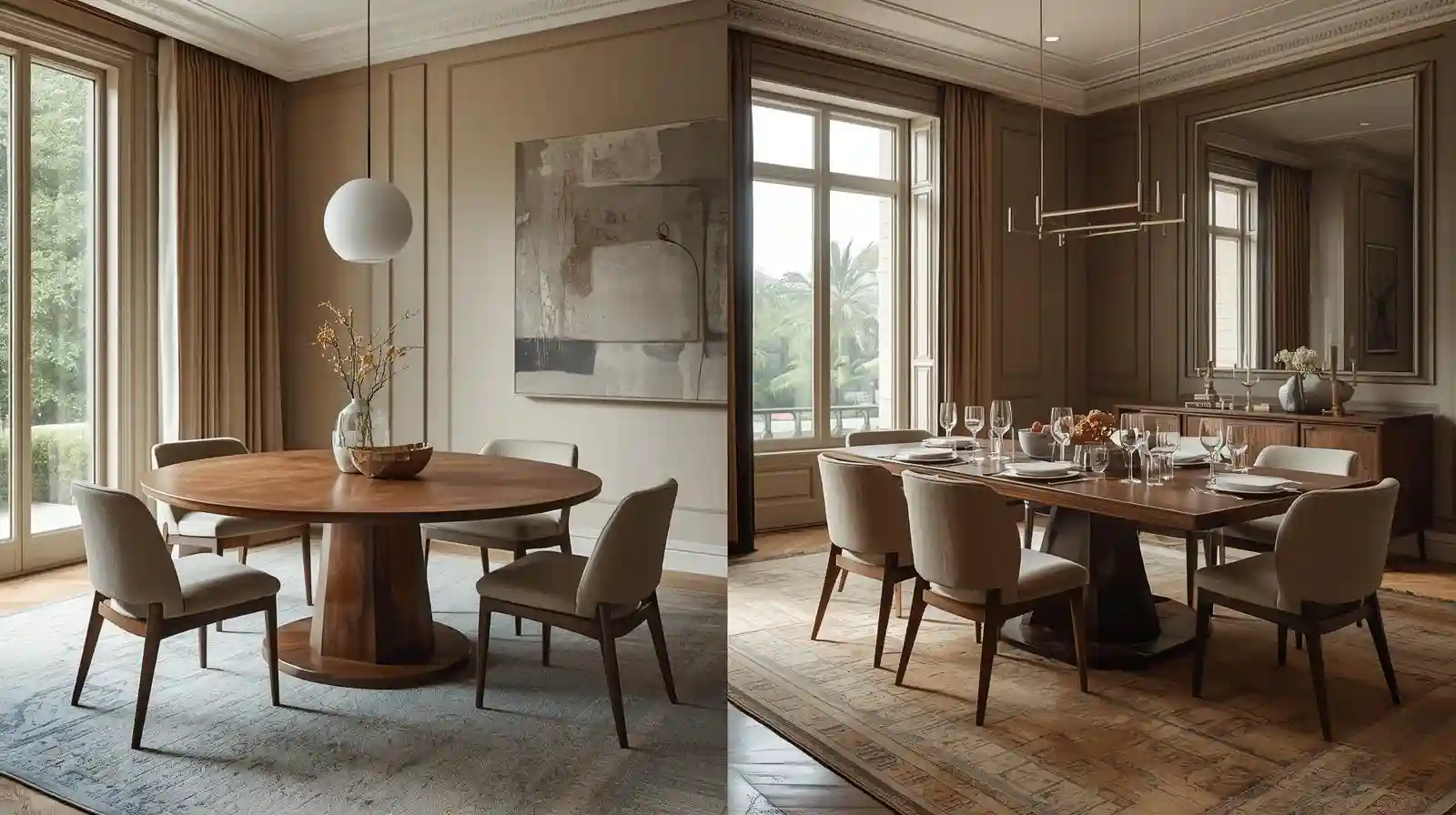
A round dining table has no head seat. Every chair position is equal, which creates a democratic, inclusive seating dynamic. The absence of corners also means round tables take up less visual space, even when the diameter is fairly large. Common diameters range from 90 cm for two people to 150 cm for six.
Round tables typically come in two base configurations: a central pedestal base (which maximises legroom and allows chairs to slide in from any angle) or four corner legs (which can restrict seating flexibility). In practice, a pedestal-base round table is almost always the smarter functional choice.
Rectangular Dining Tables
The rectangular table is the global default, and for good reason: it mirrors the shape of most dining rooms, allows seating along both long sides, and scales efficiently from four to twelve or more people. Standard widths run between 85 cm and 100 cm, with lengths starting at 140 cm for four seats.
Extendable rectangular tables, also called extension or drop-leaf tables, offer an exceptional flexibility advantage: you can seat four on a regular Tuesday and expand to ten for a dinner party. This is a feature round tables rarely offer with the same elegance.
Industry Insight: According to a 2023 survey by Houzz, rectangular dining tables accounted for roughly 62% of dining furniture purchases globally. However, in the UAE market, demand for round and oval tables has grown steadily, particularly in apartments and townhouses in communities like Dubai Marina, Jumeirah Village Circle, and Arabian Ranches, where open-plan layouts and compact dining areas make circular shapes a practical choice.
How to Choose Dining Table?
Room dimensions are the single most important variable in this decision. Getting this wrong is the number-one mistake homeowners make, and it is entirely avoidable.
The universal rule: You need at least 90 cm of clearance on all sides of any dining table for chairs to pull out comfortably and for people to walk around freely. With 75 cm for the chair itself when pulled out, you are looking at a minimum of 165 cm of total space from table edge to wall.
When to Choose a Round Table
- Your dining room is roughly square in shape
- The room is small to medium in size (under 14 square metres)
- The dining area sits in an open-plan living space with traffic flow on multiple sides
- You want the room to feel more open and less segmented
When to Choose a Rectangular Table
- Your dining room is longer than it is wide (the most common layout)
- The room is medium to large (above 15 square metres)
- You need to seat six or more people regularly
- The table will be placed against or near a wall when not in use
If your room is square, your family is four or fewer, and you value an intimate dining experience: choose round. If your room is rectangular, your family is five or more, or you host frequently: choose rectangular. If you genuinely cannot decide, then simply contact us. Our team is always available to help you in choosing the right design for your space and also build a custom dining furniture Dubai specifically for your needs.
Head-to-Head Comparison Between Round and Rectangle Table
| Factor | Round Table | Rectangular Table |
|---|---|---|
| Best Room Shape | Square rooms | Rectangular rooms |
| Ideal Family Size | 2 to 4 people | 4 to 12+ people |
| Conversation Flow | ✓ Equal, inclusive | ~ Hierarchical |
| Seating Scalability | ✗ Limited above 6 | ✓ Scales to 12+ |
| Space Efficiency | ✓ No dead corners | ~ Needs longer room |
| Extendable Options | ✗ Rare | ✓ Very common |
| Legroom (pedestal) | ✓ Excellent | ~ Varies by base |
| Child Safety | ✓ No sharp corners | ✗ Corner risk |
| Formal Dining Suitability | ~ Casual feel | ✓ Classic and formal |
| Custom Furniture Options | ✓ Many | ✓ Many |
| Average Starting Cost | AED 800 – 3,500 | AED 1,000 – 7,000+ |
How Each Shape Scales Seating Capacity?
Seating capacity is often misunderstood because people conflate table size with shape efficiency. The reality is nuanced.
A 120 cm round table comfortably seats four. A 150 cm round table seats five to six. Beyond 150 cm, round tables become impractical because the centre of the table is out of reach for conversation and passing dishes.
Rectangular tables scale far more gracefully. A 160 cm table seats six, a 200 cm seats eight, and a 240 cm seats ten to twelve. For families larger than four or households that entertain frequently, a rectangular table offers significantly more seating per square centimetre of floor space used.
Which is Better for Conversation and the Dining Experience?
Here is something the furniture industry does not emphasise enough: table shape changes how people talk to each other at dinner.
At a round table, everyone can see everyone else. There is no awkward “diagonal shouting” across a long table. Conversation flows more naturally and inclusively, which is why round tables are preferred for intimate family dinners, couples, and close friend gatherings. Research in environmental psychology, including work cited by the journal Environment and Behavior, consistently shows that circular seating arrangements encourage more equal participation in group conversation.
At a rectangular table, the person at the head of the table naturally becomes the focal point. This creates a hierarchy that suits formal dinner parties and family gatherings where one person is hosting or leading the meal. Guests seated at opposite ends of a long table often find themselves out of earshot of each other, which fragments conversation into smaller clusters.
In practice: When working with clients in Dubai who describe themselves as “we cook together, eat together, talk a lot,” the round table recommendation almost always lands better. When the brief is “we host large dinner parties and family gatherings,” rectangular wins every time. UAE households often host extended family during Eid and Ramadan, which makes seating scalability a genuinely important factor here.
Interior Style and Aesthetics
Both shapes work across a wide range of interior design styles, but each has natural affinities.
Round Tables Complement
- Scandinavian and minimalist interiors (clean geometry, no wasted corners)
- Bohemian and eclectic styles (organic feel, natural wood bases)
- Contemporary apartments (space-efficient, modern look)
- Farmhouse and rustic styles when paired with a thick wooden top
Rectangular Tables Complement
- Traditional and classic interiors (formal, structured feel)
- Industrial and loft-style spaces (long tables echo industrial aesthetics)
- Modern luxury villas (large format, statement pieces)
- Open-plan kitchen-diners (anchors the dining zone clearly)
Conclusion: Which Should You Choose?
The round vs rectangular dining table debate does not have a single correct answer, but it does have a correct process. Start with your room dimensions, then consider your family size and how you use your dining space daily. Layer in your aesthetic preferences last, not first.
When it comes to custom dining tables in Dubai, Ram Furniture is a trusted name among villa owners, apartment residents, and interior designers across the UAE. We specialise in fully custom-made dining tables, both round and rectangular, crafted to your exact room dimensions, preferred wood species, and finish.
What sets us apart in Dubai’s competitive furniture market is our end-to-end service: free home measurement visits, 3D visualisation before production, and delivery and installation across Dubai, Sharjah, and Ajman.